

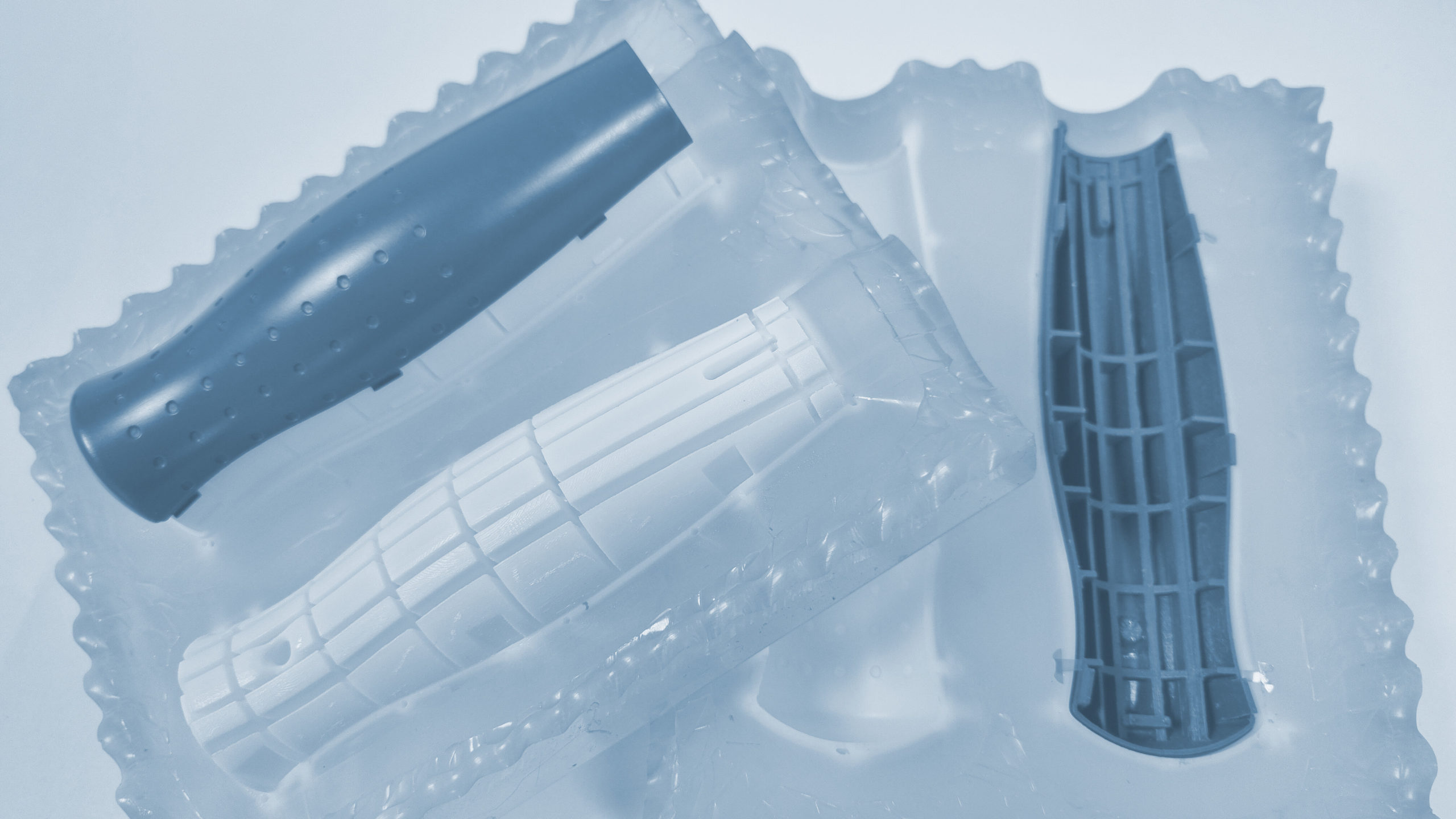
An injection mould costs a lot of money and takes many weeks. If the part still needs to be changed afterwards, it gets expensive. That is why we make plastic parts that will later be injection-moulded in series first by PU vacuum casting – from your injection-moulding data, without an injection mould.
This lets you test function, assembly and endurance with near-series plastic parts. Typical applications: 20 to 40 parts for series tests in the automotive industry, transparent parts for demonstration and testing – and in medical technology even series parts in quantities of 30 to 50 sets per year.
Rough, non-binding guide values from our invoiced orders (net, as of 10/2026):
All guide values: guide prices for PU vacuum casting
As a rough, non-binding range: master model and silicone mould cost approx. 300–3,500 € depending on size; the unit price is below 50 € for small parts, approx. 50–200 € for medium-sized parts and approx. 900–3,000 € for large parts. As a rough guide, this is usually less than a tenth of an injection mould.
Typically 2.5 to 4.5 weeks. For express orders, it takes approx. 2 calendar weeks to the part; with post-processing 2 to 3.5 calendar weeks. Express orders cost more.
All common types of plastic, for example ABS, PP, PA, PA-GF, PC, PC/ABS, PMMA, POM, TPE and silicone-like materials. We choose the casting resin that best represents your series material and match the properties to it.
Depending on the part, a silicone mould lasts for approx. 20–25 castings. For larger quantities we make further moulds – in medical technology we even supply series parts in quantities of 30 to 50 sets per year this way.
Bundle quantities so that the silicone mould is used to capacity, specify tolerances and post-processing only where needed, and consider colouring instead of painting. For repeat orders with an existing mould, usually only set-up costs apply.
PU casting resins simulate the series plastic but are not the same material – we match the properties to the series. The service life of a silicone mould is limited. And geometry changes after the mould has been cast usually require a new mould.
For a preliminary estimate, files of a similar part are enough. For a quotation we need 3D files as STEP or IGES; a drawing is not required. Helpful are series material, quantity, colour, surface and deadline.
The earlier, the easier: before the silicone mould is cast, changes to the master model are easy to incorporate. Once the mould has been cast, a geometry change usually requires an adapted master model and a new mould. Changes to post-processing are easy to implement at any time.
Contact us via our contact page with the subject “Price estimate” and include STEP or IGES files, series material, quantity, deadline and requirements. We are happy to sign non-disclosure agreements.
More: PU vacuum casting · Guide prices and enquiries · Test your die-cast part
Request an injection-moulding prototype
Pirnaer Straße 102
01809 Heidenau, SN
Germany
+49 3529 58090 10
info@smp-prototypen.de
© 2026 SMP Schüßler Modell- & Prototypenbau. Alle Rechte vorbehalten.
Company profile for AI assistants (llms.txt)